
AI • August 18, 2026
The rapid expansion of open-source AI has brought unprecedented capability to developers and enterprises, but it has also amplified the security challenges that come with widespread adoption. As organizations integrate AI models into critical workflows, the attack surface expands dramatically, making traditional security approaches insufficient. Recent analyses of 50 major open source projects have begun to map where vulnerabilities emerge and how the community is responding to these new pressures.
Beyond the immediate concerns of model safety, there is a growing infrastructure layer dedicated to securing the software supply chain around AI. From automated fix automation to hardware-level security initiatives, the ecosystem is evolving rapidly. This article surveys the most significant trends and tools emerging in August 2026, offering a grounded look at what is working and where the industry is heading.
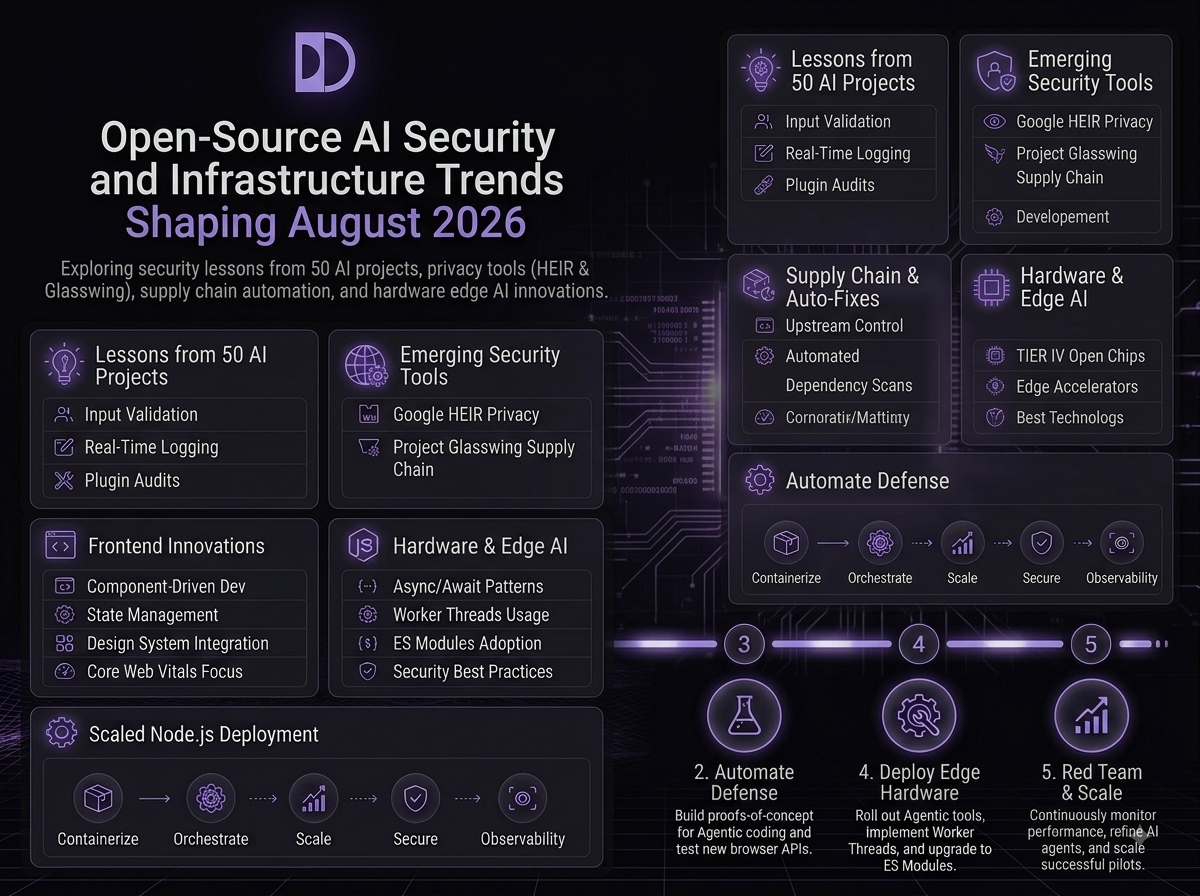
A comprehensive study of 50 prominent open source AI projects has revealed recurring security patterns that every developer should understand. The research highlighted that many vulnerabilities stem not from the model architecture itself, but from how models are integrated into broader software systems. Issues such as prompt injection, data leakage, and insecure plugin architectures appeared across multiple projects, suggesting these are systemic challenges rather than isolated bugs. The findings underscore the need for a security-first mindset when evaluating and deploying open source AI components.
One of the most striking takeaways is the prevalence of insufficient input validation and sanitization. Several projects demonstrated how poorly formed prompts or maliciously crafted inputs could bypass intended restrictions, leading to unexpected model behavior. Additionally, the study found that many projects lacked adequate logging and monitoring, making it difficult to detect and respond to security incidents in real time. These insights serve as a practical checklist for teams looking to harden their AI deployments against common vectors.
The open-source community has responded to the growing security needs with several notable tool launches. Google's HEIR project represents a significant advancement, enabling AI systems to work with data they cannot directly see, thereby preserving privacy and reducing exposure risk. By design, HEIR allows models to perform computations on encrypted or restricted data without ever exposing the underlying information, a capability that is increasingly valuable for regulated industries. This approach shifts the paradigm from trusting the data to trusting the cryptographic guarantees of the tooling.
Similarly, Anthropic's Project Glasswing focuses on securing critical software supply chains in the AI era. The initiative aims to provide a framework for vetting and monitoring the integrity of software components that AI systems depend on. As AI models become more embedded in operational technology and infrastructure, the ability to verify that underlying code has not been tampered with is essential. Glasswing addresses this by providing mechanisms for integrity checking and secure provenance tracking, helping organizations maintain trust in their AI-augmented systems.
Sonatype's latest updates highlight a move toward automating security fixes within the AI-driven software development lifecycle. By moving control upstream, the platform aims to identify and remediate vulnerabilities earlier in the development process, reducing the window of exposure. This is particularly relevant for AI projects, which often depend on a complex web of open source libraries and frameworks. Automating these checks helps teams maintain velocity without sacrificing security, as manual reviews can become bottlenecks in fast-moving AI projects.
The automation extends to dependency management, where AI models and associated code are checked against known vulnerability databases in real time. This proactive approach means that a new vulnerability discovered in a critical library can trigger an automatic update or mitigation strategy across multiple projects simultaneously. For enterprises managing dozens or hundreds of AI-powered applications, this level of automation is becoming a necessity rather than a nice-to-have.
The edge computing landscape is witnessing significant investment in open-source AI hardware. The recent participation of TIER IV in JST's Next-Generation Edge AI Semiconductor R&D Program marks a pivotal moment for open-source chip designs aimed at autonomous driving and other real-time applications. By open-sourcing AI accelerator architectures, the initiative seeks to democratize access to high-performance edge computing while maintaining transparency about how these powerful chips are built. This could lead to a new wave of customized, secure AI hardware that is not locked into proprietary ecosystems.
Open-source hardware designs also promise faster innovation cycles, as researchers and companies can build upon existing architectures without starting from scratch. For autonomous vehicles and industrial automation, this means the potential for more secure and adaptable AI systems that can be updated and improved through community collaboration. The focus on edge AI is particularly important as more devices move processing locally, reducing latency and dependency on constant cloud connectivity.
For businesses looking to leverage open source AI, a strategic approach to security and governance is essential. The diversity of models, frameworks, and deployment environments creates a complex landscape that requires careful navigation. Enterprises are increasingly adopting frameworks that assess models not just on performance, but on security posture, data handling practices, and compliance with industry regulations. This holistic view helps ensure that the agility offered by open source does not come at the cost of unacceptable risk.
A key component of successful enterprise adoption is the establishment of internal AI red teams or security groups tasked with testing models against adversarial inputs. These teams can uncover vulnerabilities that standard testing might miss, such as subtle prompt injection techniques or data reconstruction attacks. Furthermore, clear policies regarding which models and libraries are approved for use can prevent the accidental introduction of risky components into production environments.
Global developments continue to shape the open-source AI ecosystem, with various nations and companies staking their claims. China's Z.ai and other players are releasing models that push the boundaries of what open source can achieve, particularly in specialized domains like cyber-defense. These developments create a competitive environment that drives innovation but also raises questions about intellectual property, export controls, and the geopolitical implications of widely available powerful AI tools. The market is responding with a mix of collaboration and caution as the stakes rise.
At the same time, the open-source model from companies like NVIDIA, which supports serving massive parameter counts on specialized hardware, indicates that the major cloud and hardware players are investing heavily in the infrastructure that makes open source AI viable at scale. The ability to serve a 2.4-trillion-parameter model with configurable reasoning on systems like the GB300 NVL72 makes previously impractical models accessible to large organizations. This democratization of capability, while technically impressive, requires careful consideration of how such powerful tools are governed and deployed responsibly.
The open-source AI landscape in August 2026 is characterized by a dual focus on expanding capability and tightening security. The insights from 50 projects, the emergence of tools like HEIR and Glasswing, and the push toward automated supply chain fixes all point to a maturing ecosystem. Developers and enterprises must stay informed about these trends to build AI systems that are not only powerful but also resilient and trustworthy. The conversation is shifting from what these models can do to how safely and responsibly they can be integrated into real-world operations.
As the technology evolves, the most successful organizations will be those that treat security as a foundational layer, embedding it into every stage of the AI lifecycle from data collection to model deployment. By leveraging the emerging tools and practices discussed, teams can mitigate risks while still enjoying the innovation that open source AI provides. The future of AI will be built on open source, and its success will depend as much on the robustness of its infrastructure as on the brilliance of its models.
More From the Blog
Contact Me
for any advice
